Thursday, June 22, 2023

Cashless Payments Influence Impulse Buying Behaviour


INTRODUCTION

Consumers today are more likely to purchase a product on a whim, regardless of whether they are shopping online or in-store. Consumers become increasingly prone to making rash decisions as time passes. Numerous individuals engage in more casual or compulsive shopping, particularly via online channels. As technologies have advanced, debit and credit cards, e-wallets with quick response (QR) code options, contactless cards such as SamsungPay, ApplePay, MAE, and the Buy-Now-Pay-Later (BNPL) feature, as well as many others have become more prevalent, thereby accelerating the process of making a purchase. With mobile wallets gaining the most traction among first-time users (33%) followed by online cards (30%) and QR code payments (26%), cashless payments are on the rise (Visa, 2022). As a result of this significant shift in consumer behaviour and the widespread adoption of digital payment methods, Malaysia is gradually becoming a cashless society.


IMPULSE BUYING BEHAVIOUR

The term "impulse buying" describes a type of shopping behaviour characterised by a strong desire to make an unplanned purchase despite negative emotional and rational considerations (Zhao et al., 2022). Customers have access to a variety of payment options, thus allowing them to purchase their desired items quickly and easily. Moreover, compared to those who pay with cash, consumers who use credit cards or other electronic payment systems tend to underestimate their expenditures (Xu et al., 2022). Consequently, consumers are likely to make impulsive purchases as they can pay with a single click or wave. They will not give their purchases much thought, leading them to act impulsively. In fact, a Bankrate study found that 64% of the shoppers who purchased something from an advertisement said that they regretted at least one of these purchases (Foster, 2022). 

Retailers and other industries such as the food and beverage industry are pressured to adapt their customer service strategies because of changing consumer preferences. According to the Visa Consumer Payment Attitudes study, most Malaysians (55%) can go cashless for more than a week, and 74% of consumers in Malaysia have successfully gone cashless, with most digital payments being made using the card online (70%), contactless card (56%), and mobile contactless payment (32%). The study also reported that 93% of Southeast Asian consumers use a variety of cashless payment methods such as cards, contactless cards, mobile contactless, mobile wallets, and QR code payments (Visa, 2022). This is led by consumers from Singapore (97%), Malaysia (96%), Indonesia (95%), and Vietnam (95%). Other than that, the study reported that most consumers did not only view cashless payment as a safe option, but they also supported their governments' plans to transform their countries into cashless societies. 

Using radio frequency identification (RFID) and near-field communication (NFC) technologies, these contactless payment methods enable customers to pay with debit and/or credit cards or smartphones. Payments made with a contactless card, for example, do not require a personal identification number (PIN) or signature, thereby expediting the transaction. Given that this reduces the time spent contemplating a purchase, it may encourage impulsive purchases. 49 Moreover, the BNPL option encourages consumers to purchase products without waiting for a financial emergency. Over one-third of shoppers (35%) say they will continue to make impulsive purchases during inflation because the price is "too good to pass up" (Foster, 2022). As a means of ensuring that they can continue living as they have been, they will seek it out. Since they can now purchase an item for which they have not had time to save, they are more likely to make a large purchase quickly. 

Cashless payments are becoming increasingly common among younger consumers including Millennials and Generation Z, as they are the primary drivers of this trend. Using an e-wallet to make a purchase is enjoyable for these generations of consumers, and this has a positive impact on their propensity to make impulsive purchases (Lee et al., 2022). The preference of young customers for cashless payment methods influences their shopping frequency. They are prone more to making impulsive purchases compared to other generations. This may result in these young consumers incurring excessive debts. Therefore, it is crucial for both marketers and consumers to gain an understanding of what motivates young buyers to make impulsive purchases and to develop effective tools to combat this behaviour. 

As a part of the government's initiative to "transform Malaysia into a digitally driven, high income nation and a regional leader in the digital economy," Universiti Teknologi MARA (UiTM) has adopted cashless payment and is poised to become Malaysia's largest cashless campus. The "UiTM Go Cashless – Make Life Easier" slogan has been applied to UiTM campuses as a part of the initiative to migrate from cash to cashless payments. UiTM and Merchantrade have recently signed a Memorandum of Understanding (MoU) to provide a digital wallet service to international and outbound students enrolled in UiTM, the University’s employees as well as a million active alumni members (Ignatius, 2023). Students and staff of UiTM, who are also among the Millennials and Generation Z, will be able to conduct financial transactions digitally, exchange digital currency, manage their card settings, and routinely track their expenses.


CONCLUSION

The proliferation of cashless payment methods among Malaysian consumers contributes to economic growth. Consumers can now make purchases online and offline using a variety of payment options provided by retailers. Since the convenience of cashless payment methods offered by merchants encourages consumers to make impulsive purchases, consumers must manage and plan their financial flow. Individuals who make impulsive purchases could jeopardise their financial planning as they may incur debt and be unable to manage their financial situation. In response to public financial planning crises, marketers should remain vigilant and continue monitoring the consumer base to distinguish between true demands and impulsive purchases. 


REFERENCE

Foster, S. (2022). Social media is making you more prone to impulse purchases – here’s how to avoid buyer’s remorse. The Star. https://www.thestar.com.my/tech/technews/2022/08/29/steps-to-stop-impulse-buying 

Ignatius, C. (2023). UiTM, Merchantrade Collaborate To Provide Digital Wallet Service. Business Today. https://www.businesstoday.com.my/2023/01/30/uitm-merchantrade-collaborateto-provide-digital-wallet-service/ 

Lee, Y. Y., Gan, C. L., & Liew, T. W. (2022). Do E-wallets trigger impulse purchases? An analysis of Malaysian Gen-Y and Gen-Z consumers. Journal of Marketing Analytics, 0123456789. https://doi.org/10.1057/s41270-022-00164-9 50 

Visa. (2022). Visa Consumer Payment Attitudes Study 2022 - Navigating a New Era in Payments. https://my.review.visa.com/dam/VCOM/regional/ap/documents/visa-cpa-report-smt2022.pdf 

Xu, C., Unger, A., Bi, C., Papastamatelou, J., & Raab, G. (2022). The influence of Internet shopping and use of credit cards on gender differences in compulsive buying. Journal of Internet and Digital Economics, 2(1), 27–45. https://doi.org/10.1108/jide-11-2021-0017 

Zhao, S., Yang, Q., Im, H., Ye, B., Zeng, Y., Chen, Z., Liu, L., & Huang, D. (2022). The impulsive online shopper: Effects of Covid‑19 burnout, uncertainty, self‑control, and online shopping trust. Future Business Journal, 8(1), 1–58. https://doi.org/10.1186/s43093-022-00174-0


To cite the paper, you may visit HERE.

Monday, August 3, 2020

Cover Letter - Submitting Manuscript

Assalamu'alaikum. Today I want to share the contents of the cover letter since it needs to be submitted together with our manuscript for publication.

1. Relate our paper with the scope of the journal
2. Answer the key result our paper address
3. Make sure the name of the editor and journal are written correctly
4. Mention what type of our article
5. Explain how our paper fit their journal
6. Don't put abstract in the cover letter
7. One side of the paper only and written in 12 point
8. State that our manuscript is not published and is not being considered by any other journal

That's all. See you in the next post. Take care!

Sunday, July 26, 2020

High Impact Journal - Conceptual Paper

All should realize that it is not so difficult to publish a conceptual article. Shouldn't there be data included? No respondents? It's alright. Your article can still be written and published even in high index journals.


Source: From Google

First, do we know how to write conceptual papers? It's all about creating new awareness. We must, therefore, choose the sources of information before we can generate new knowledge. The argument is, obviously, not taken from the data but from the collection of proof of previously established ideas and hypotheses, as we write theoretical papers, too.

Two primary methods are a focus phenomenon and a focus theory to explain how and why ideas and hypotheses are selected.


Focal phenomenon:- we must first define the various concepts of the phenomenon and then argue for the dimension of concern better discussed particular concepts or theories.

Focal theory:- we argue that in some respects, the current idea or theory is not enough or incomplete, and we then present new approaches to resolve the shortcomings. Such shortcomings in previous work have to be addressed.

We will clarify how and why the principles and hypotheses have been chosen for writing conceptual articles. All right, let's move on to principles and hypotheses claims now. How can we argue about this? The arguments -> reasons -> warrants are CGW.

Claims are the assertion that the reader must be acknowledged as valid. That is the product of the study, in other words. The reasons for supporting the argument and persuading the reader are the ground, and the underlying premises that relate the reasons to the claims are warrants.

You can follow four approaches: theory synthesis, theory adaptation, typology and model.

1. Theory Synthesis
In this method, the published paper incorporates several theories or literature sources. Researchers linked the unconnected and incompatible pieces by providing a new or enhanced view of concept or phenomenon. They contribute by summarizing and incorporating the current concept of the idea or phenomenon. They may also investigate the conceptual underpinnings of an emerging theory or clarify the contradictory study results.

2. Theory Adaptation
This method enables us to revise the scope or perspective of an existing theory by informing it of other theories or perspectives. The conceptual scope may also be changed or extended by switching the level of analysis. Another way is to define new dimensions of an established construct by introducing a new theoretical lens.

3. Typology
A typology paper identifies the critical dimensions of a concept to address contradictory findings from previous studies. We may also demonstrate how variants of an entity differ and establish dynamic networks of concepts and relationships to explain a phenomenon.

4. Model
A model paper explains and predicts relationships between concepts. This paper constructs a theoretical framework that predicts relationships between constructs. First, we define the interactions between constructs, then add new constructs and/or relationships between constructs. Finally, we explain why a series of events occur.

These are the four vital methodological requirements to publish a conceptual paperBreak a leg! I know we can do it!

Sunday, June 28, 2020

SmartPLS - Measure Validity

We need to evaluate the measurement model before we can know how reliable and valid the model is. As I explained in the earlier post HERE, reliability can be measured by assessing the composite reliability and Cronbach's Alpha whereas validity can be measured through convergent and discriminant validity.

Have you download SmartPLS software? If "YES", you can just proceed to test the validity. If "NO", you can download the software and install it into your computer. In this post, I'll show you step by step on how to calculate validity. 

First, we need to examine the cross-loadings since they are the dominant approaches to measure discriminant validity.

Step 1: Asses indicator loadings by clicking "Default Result" --> "PLS" --> "Calculation Results" --> "Outer Loadings"


The table below shows a complete table of the outer loadings
From the table, we can see that all reflective indicators have loadings of 0.636 and higher. SmartPLS provide outer loadings and outer weights for all construct in the PLS path model, regardless of whether they are measured reflectively or formatively.

Step 2: Assess the Fornell-Larcker criterion, click "Report" --> "PLS" --> "Quality Criteria" --> "Latent Variable Criterion


This is the last step in analysing the cross-loadings. For reflective measurement model, we use Fornell-Larcker criterion. Fornell-Larcker criterion is the second and more conservative approach in assessing discriminant validity. It compares the square root of the AVE values with the latent variable correlations. The square root of each construct's AVE should be greater than its highest correlation with any other construct. The logic of this method is based on the idea that a construct shares more variance with its associated indicators than with any other construct.

The table below shows the Fornell-Larcker criterion before we calculate the square root of AVE

From the table above, we include the values of the square root of AVE


Finally, the table of Fornell-Larcker criterion is complete

These are the needed step in measuring the validity through SmartPLS. So, how can we explain those number? What are those number supposed to mean? Actually, you can refer these papers, HERE and HERE to understand how to analyse our collected data.

Till next time. Be safe and take care! 

Let's fight Covid-19 together!

Wednesday, April 1, 2020

SmartPLS - Measure Reliability


Have you ever heard about PLS? If "YES", it means that you are already in Chapter 4 (Data Analysing). It just few more steps before you can complete your thesis. So, how can we measure PLS model? The answer is, we need to first measure whether our model is reliable or not. Reliability can be measured by assessing the composite reliability and the Cronbach's Alpha of the model whereas validity can be measured through convergent and discriminant validity.

First of all, we need download the SmartPLS software from HERE and install it into our computer and click 'Run'. The software will be automatically installed.

In this post, I'll show you step-by-step how to calculate reliability through SmartPLS. Fyi, I use SmartPLS version 2 since it FREE. Hehehe.

Step 1: Click the draw button and design the IVs and DV


Step 2: Click "Calculate" --> PLS Algorithm


Step 3: Calculate the PLS. Click "Finish"


Step 4: Remove the loading items less than 0.6. According to Hair et al., (2011), the loading should be more than 0.6


Step 5: The remaining items should be greater than 0.6


Step 6: The items with value greater than 0.6 remain in the model and ready to be calculated


Step 7: Retrieve the composite reliability (CR), Cronbach's alpha and Average Variance Extracted (AVE) by clicking "Report" --> Html (Print) Report


Step 8: The report will be exported to HTML and we can still access the data offline. How great isn't it? No need to worry even if we have an unstable Internet connection (^_^)


Step 9: The first criterion to be evaluated is typically internal consistency reliability. The traditional criterion for internal consistency is Cronbach's alpha. In PLS we are using internal consistency reliability to represent the Cronbach's alpha.


Step 10: Copy the table


Step 11: The table can be "paste" [ctrl+v] in the Microsoft Excel. Then, highlight the value of Cronbach's Alpha and click "decrease decimal" to reduce the decimal point. So, it can increase the readability. 


Step 12: The value of Cronbach's Alpha now can be easily read


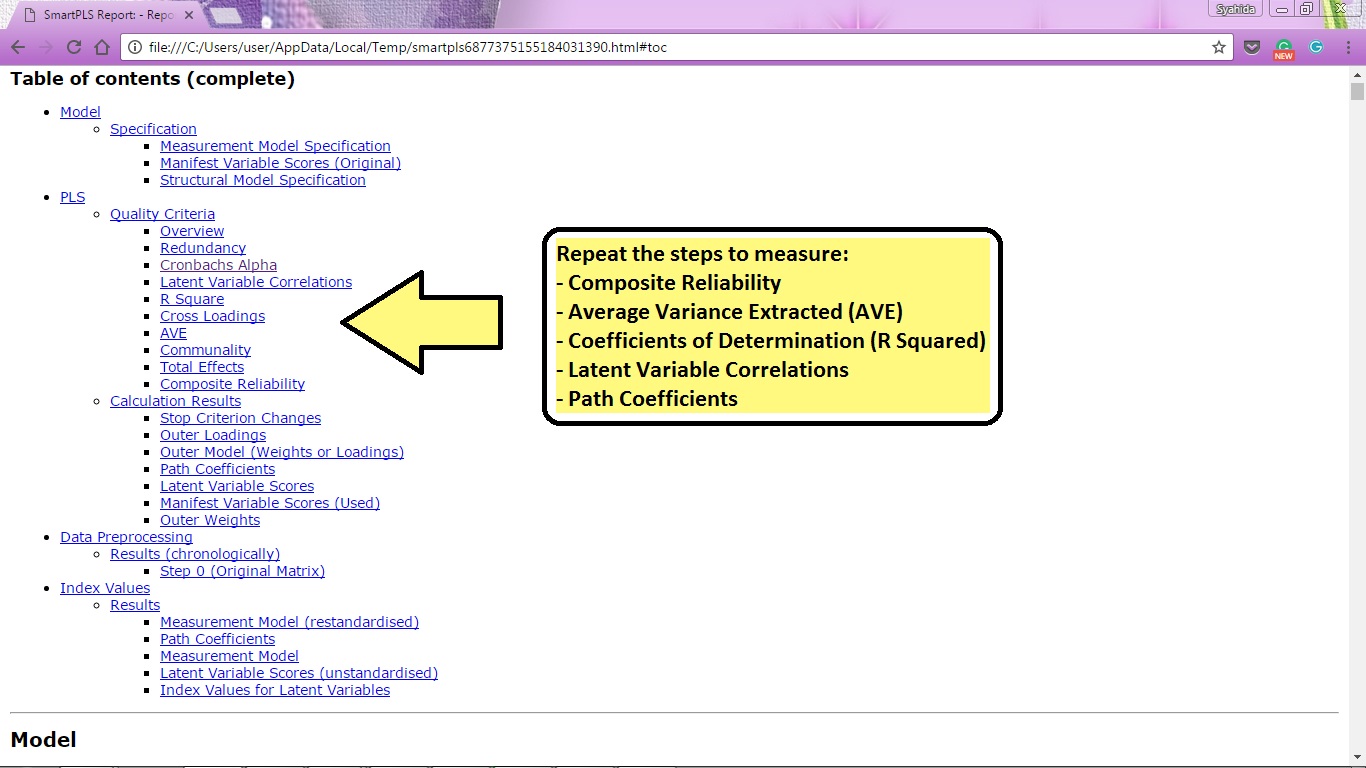
Step 13: Repeat Step 9 to Step 12 to calculate the value of Composite Reliability, AVE, Coefficients of Determination (R2), Latent Variable (LV) correlations and Path Coefficients.


Step 14: Copy the overview of result and "paste" in Microsoft Excel

Step 15: This is how the result looks like in Microsoft Excel before we reducing the decimal points and re-design the table below before we can include it in our report.


From the result, it shows that all reflectively measured constructs have AVE values of 0.605 and higher, which is considerably above the critical value of 0.5. The AVE value of at least 0.5 indicates sufficient convergent validity, meaning that a latent variable is able to explain more than half of the variance of its indicators on average. In addition, all composite reliability values are well above the critical threshold of 0.7.

These are the steps in measuring reliability through SmartPLS. But, how can we explain those numbers? What are the meaning of those numbers? To guide you in analysing those numbers, you can refer these papers HERE and HERE. These papers also explain further on structural model evaluation and hypothesis testing.

That's all for now. 

Till next time and take care! (^_^)

Tuesday, March 17, 2020

Meta-Data Analysis

Meta-data analysis is the earliest step that students need to conduct before they can start writing their thesis or dissertation. This method is also known as systematic LR and systematic review, systematic analysis.

When I prepared my meta-data analysis, I analysed more than 300 articles before I know which specific topic to be researched and what we need to investigate in order to bridge the gap in the literature.

As for the first step, I gathered all the related articles that examined the dimensions of brand loyalty. This is how we can divide the column in the Meta-Analysis. The column includes name of author(s), Independent Variable (IV), Dependent Variable (DV), Interverning Variable (IIV) and/or Moderating Variable (MV), Methodology, Findings and Limitation/Recommendation/ Future Research.


We can gather more than 200 articles. It depends on how many articles you can retrieve. The more the better. By doing this, apart from we can understand the entire topic better, we can understand how previous researchers conducted their research and what are the limitations in their research. From there, we can find the need for future research to be done. 

As for the next step, we sort the elements out of the articles and categorise them into different group.


As we can see here in the figure above, I categorised the articles based on which author(s) measure IVs that influence DV. Some researchers measured only one element of brand loyalty while some other researchers measure two and more elements of brand loyalty. The IVs in my research consist of the factors that influence brand loyalty.


I also categorised which articles examined the mediating or intervening variable (IIV) in the brand loyalty relationship. So, from this analysis I can understand why researchers measure certain variables and left out other variables and why they need to measure the intervening effect on the relationship and what are the reason behind of their selection.

Based on these figures, we can now seek the research gaps and do our research. At the recommendation and future research section there are limitations of the present research. From there we can get an idea of what to examine in order to bridge the gaps.

For further reading on conceptual papers regarding meta-data analysis, I've prepared two papers. First paper, it's regarding the elements used in measuring customer brand loyalty in which you can view, cite and download it HERE


As for the second paper, it is a meta-analysis through a summary of literature review on brand loyalty with the inclusion of mediating variable, in which you can view, cite and download it HERE.


I strongly believe that this meta-data analysis really need consistency and hard work from you. No pain no gain. Wish you all the best in sorting out the needed information from your numerous gathered articles/papers.

Love,
Dr SAA

Saturday, February 29, 2020

Reliability and Validity Analysis

Previous scholars have shown that Partial Least Squares (PLS) is a robust technique that has been frequently used in the literature. In PLS, to analyse a model, we need to follow the two-step procedure which are the measurement model and structural model (Hair et al. 1998).

1. Measurement Model
In this step, we measure convergent validity and discriminant validity

What are the purpose of measuring convergent validity? The reason for analysing convergent validity is to measure the close relations exist among the items of the same construct. We need to measure composite reliability (CR) and average variance extracted (AVE).


In PLS, the factor loading should be greater than 0.7 (Hair, 2013). We need to remove items loading with less than 0.7 to increase CR or AVE in the first order of the component of independent variables (IVs).

Fornell and Larcker (1981) stated that the CR values should be more than 0.7 and AVE should be greater than 0.5 in order for the result to be accepted. Convergent validity is established if all the values of CR are greater than 0.7 and all the values AVE in a study are greater than 0.5. To know more about how to calculate CR and AVE, you can click HERE (Scopus-indexed journal).


Discriminant validity explains the degree of irrelevance between constructs. To measure discriminant validity, there are two steps which are confirmatory factor analysis and AVE analysis. All items should have high loading on their corresponding constructs. Then, we calculate the square root of the AVE that exceed the inter-correlation of the construct in the proposed model. In order to support discriminant validity, each construct's AVE square root should be greater than its correlations with other constructs. 

To see more about the explanation in analysing convergent and discriminant validity you can either click HERE or HERE


2. Structural Model
Structural equation modelling tested the hypothesised paths of the structural model. All coefficient estimates were significant (p<0.05) in accordance with the hypothesised directions. In testing the proposed hypotheses, the standardised path coefficient is expected to be at least 0.2 and preferably greater than 0.3 (Chin and Newsted, 1999).

The reliability of the coefficients in the study is obtained through a bootstrapping procedure (500 resamples). All t values need to be higher than the theoretical t value of 2.57 for a 5% probability of error. Meanwhile, the p values of 0.000 indicate that all path relationship are significant at a 5% probability of error.


Predictive accuracy of a model can be measured by analysing the coefficient of determination. A rule thumb on the acceptable coefficient of determination is 0.75, 0.50 and 0.25, explaining substantial, moderate or weak level of predictive accuracy, respectively (Hair et al., 2014).

For further explanation on how to calculate the structural equation model analysis and how to explain the predictive accuracy of the model, you can click HERE (Scopus-indexed journal).


Love,
Dr SAA
2

Friday, December 20, 2019

What is Unidimensionality?

Unidimensionality is always been described as a specific type of measurement scales. It has only one (uni) dimension. Unidimensionality refers to the existence of a single trait or construct underlying a set of measures (Gerbing & Anderson, 1988).

The confirmatory factor analysis (CFA) assess the internal and external consistency of unidimensionality implied by a multi indicator measurement model that cannot be assessed by Cronbach Alpha and item to total correlation. The additional unidimensionality test were added to suit SEM analysis.


Unidimensionality can be achieved if the factor loadings of the measuring items for the respective latent construct are acceptable. Factor loading which is too low should be deleted for the model to be unidimensionality.


(ref: From an article with interaction effect, HERE)

Monday, September 2, 2019

Why Use PLS

Source: From Google

There are several reasons why postgraduate students prefer to use PLS in measuring their model. Hair et al., (2013) listed several reasons for using PLS to measure model:
  • PLS can be used for theory confirmation or theory development.
  • PLS makes fewer demands regarding sample size (e.g. <20).
  • PLS better than CBSEM when data were normally distributed, with a small sample size and correlated exogenous variables.
  • PLS does not require normal-distributed data. [CBSEM use the usual maximum likelihood estimation method, which assume multivariate normality]
  • PLS can be applied to more complex structural equation model.
  • PLS able to handle both reflective and formative construct.
  • PLS is better suited for theory development than for theory testing.
  • PLS is especially useful for prediction (prediction intention). Prediction is more important than parameter estimation.
  • PLS has ability to handle multicollinearity among IVs and small samples.

Tips for VIVA: Examiners might ask you, why you choose this PLS rather than SEM, SPSS or other statistical tools? Sometimes, they might ask why you use PLS 2 but not PLS 3? So, try find the answer for these questions before attending your VIVA session. 

I wish you all the best in your VIVA! You can do it!

Reference:
Hair, Jr. J. F., G. Tomas Hult, C. Ringle, and M. Sarstedt. “A primer on partial least squares structural equation modeling (PLS-SEM)”. Thousand Oaks, Sage, 2013.

Tuesday, September 25, 2018

Basic Concept of PLS


What is PLS? 

PLS is an acronym for Partial Least Squares. There are actually many alternatives for students to measure the reliability and validity of a model. For example, they can use either IBM software for SPSS, SmartPLS software for PLS, SEM, AMOS or other statistical software. However, during my study, I have employed PLS to measure the research model.

The process of analysing the data can be done by using the statistical software SmartPLS (Smart PLS 2.0) for Windows or PLS. In an investigation, a structural equation modelling approach using PLS technique is employed to evaluate the proposed hypotheses through the research model.

SmartPLS performs a Confirmatory Factor Analysis (CFA) while evaluating the partial least squares (PLS). The examination on CFA is done to confirm the subscales to be in the right group. The application of CFA is particularly appropriate in an investigation if there is an argument about the dimensionality or factor structure of a scale or measure (Kelloway, 1998). Hence, conducting CFA in an investigation would assist the researcher to address the issues arising in the construct validity that is related to the measurement of scale. The investigation conducts a Cronbach alpha test to solve the issues related to the scale measurement reliability. As for the last analysis, Partial Least Square Path Modeling is measured with an attempt to examine the bond between latent variables.

According to Hair et al. (2014), PLS-SEM is a prediction-oriented, variance-based approach to SEM that is based on limited predictions about the distribution of the variables. PLS-SEM denoted as PLS path modelling (PLS-PM) is primarily used to extend theories in exploratory researches by focusing on explaining the variance in the dependent variables as the researchers measured the model (Hair et al., 2013). PLS is justified to have assumptions on non-normal data, small sample sizes and formatively measured constructs (Hair et al., 2014).

Hair et al. (2013) insisted that PLS-SEM can extensively estimate the path relationships in the model using the available data as it minimizes the error terms, which is the residual variance of the endogenous constructs. The researchers further listed the data and model characteristics of PLS-SEM which included: (i) Sample size is small and or the data are non-normally distributed; (ii) Achieve a high level of statistical power with small sample sizes; (iii) Larger sample sizes increase the precision of PLS-SEM estimations; (iv) No distributional assumptions; (v) Handle extremely non-normal data; (vi) Handle construct measured with single and multi-item measures; (vii) Handle both formative and reflective measurement models equally well; (viii) Handle complex models with many structural model relations; (ix) Larger numbers of indicators are helpful in reducing the PLS-SEM bias.

Moreover, researchers also benefit from high efficiency in parameter estimation when applying PLS-SEM instead of CB-SEM (i.e. Covariance-based SEM). To sum up, the several reasons why we use PLS to calculate the measurement model are:
  • PLS can be used for theory confirmation or theory development
  • PLS makes fewer demands regarding sample size (e.g. <20)
  • PLS better than CBSEM when data were normally distributed, with a small sample size and correlated exogenous variables
  • PLS does not require normal-distributed data (CBSEM use the usual maximum likelihood estimation method, which assumes multivariate normality)
  • PLS can be applied to more complex structural equation model
  • PLS able to handle both reflective and formative construct
  • PLS is better suited for theory development than for theory testing
  • PLS is especially useful for prediction (prediction intention - prediction is more important than parameter estimation)
  • PLS has the ability to handle multicollinearity among IVs and small samples

The calculation of reliability and validity using PLS method use can be further viewed in these articles published. The influence of a moderator on the relationship also been measured in these articles:


That's all for now. 
I will update on how to measure PLS model in the next post. 


Wassalam.


Love
Dr SAA